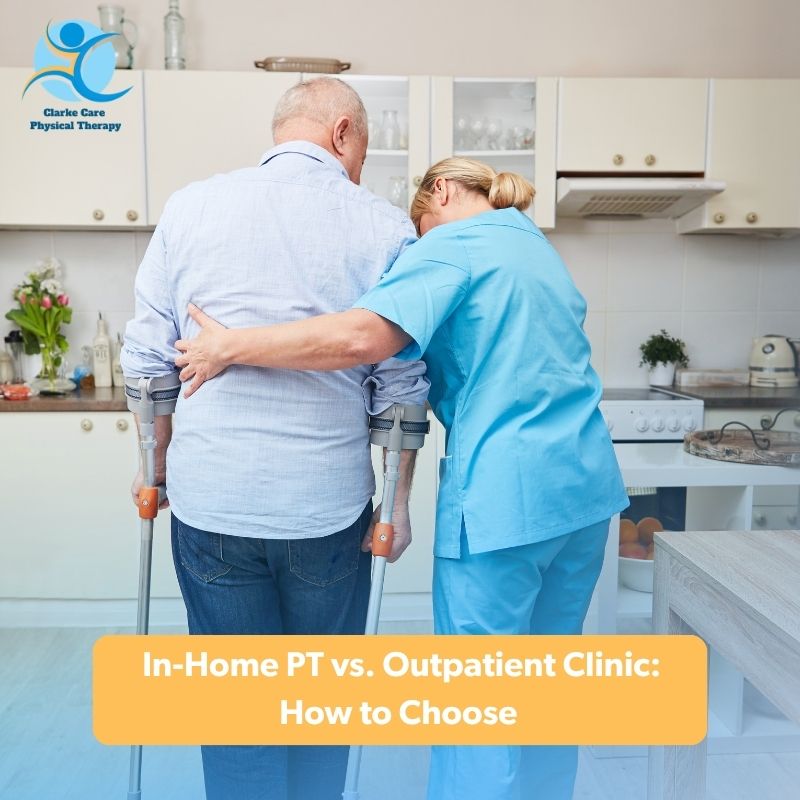
If getting to a clinic is difficult, or the thing you’re trying to get better at happens inside your home, like stairs, getting in and out of the tub, or getting up from a chair, in-home physical therapy usually makes more sense. If your recovery depends on specialized equipment, you’re training to return to competitive sport, or getting out of the house is part of what keeps you going, a clinic is often the better choice. The care itself, meaning the evaluation, hands-on treatment, and exercise progression, is held to the same standard either way.
That’s the short answer. The longer answer depends on four things: what you’re recovering from, what your home looks like, what you’ll actually stick with, and what your insurance covers.
What’s the same either way
A licensed physical therapist evaluates you and writes your plan of care in both settings. New York’s direct access rules apply identically, so you get the same 10 visits or 30 days without a referral. Most insurance plans cover in-home physical therapy the same way they cover clinic visits. And the documentation, progress measurement, and goals are the same.
The difference is the setting, and that setting changes more than people expect.
Where in-home PT has the edge
When getting there is part of the problem. After a joint replacement or major surgery, many patients aren’t cleared to drive for several weeks. That means relying on family for rides two or three times a week, and for someone who’s unsteady on their feet, every trip through a parking lot is a fall risk. Removing the trip removes the risk. This is why post-surgical recovery is one of the most common reasons people choose in-home care.
When the problem lives in your home. A clinic can simulate a staircase. We work on yours: the height of your steps, the railing that’s only on one side, the bathroom doorway your walker barely fits through. Progress made on the obstacles you actually face carries directly into daily life, which matters most for balance and fall prevention.
One-on-one time. Some clinics schedule more than one patient per therapist per hour, or hand parts of the session to aides. An in-home visit is one therapist with one patient for the whole session.
Family involvement. A spouse or adult child can be there for the session and learn how to help safely, instead of guessing at home what the therapist meant.
Children. Kids often do their best work in a familiar place, and the setting lets us work on the tasks their day actually involves. That’s a big part of what makes pediatric physical therapy at home effective.
Time. No commute, no waiting room. For people balancing work or caregiving, that often makes the difference between finishing a plan of care and quitting halfway.
Where a clinic is the better choice
We’d be doing you a disservice if we pretended in-home care is right for everyone.
Late-stage sports rehab. Returning to cutting, sprinting, or jumping sports after an ACL reconstruction eventually requires space, heavy loading, and testing equipment that doesn’t fit in a living room. Early-phase rehab works well at home. The final return-to-sport phase usually belongs in a clinic or performance facility.
Equipment-dependent treatment. Some treatment only happens in a facility. Aquatic therapy needs a pool, and some later-stage strength work needs machines and racks that don’t fit in a home. If your plan calls for either, a clinic is the right place for that part of your recovery.
When getting out is part of the goal. For some people, the trip to a clinic, the routine, and the other patients are part of the recovery. If staying home would mean staying isolated, that matters.
Insurance and network. If your plan covers a nearby clinic in-network and we’re not in your network, the cost difference can be real. Check before choosing.
Many people use both
It’s common to start at home right after surgery, when mobility is lowest and the risks of travel are highest, and then move to a clinic for the later, equipment-heavy phase. When that’s the right path, we’ll tell you.
Questions to ask yourself
- Can I get to a clinic safely, two or three times a week, for the next six to twelve weeks, without depending on someone else for rides?
- Is my main goal something I do at home, or something I do out in the world?
- Does my recovery need equipment beyond what fits in a home?
- Which option will I actually keep showing up for?
- What does my plan pay for each?
Questions to ask any provider, clinic or home
- Will I see the same physical therapist every visit?
- How long is each session, and is it one-on-one the whole time?
- Who carries out my treatment, a PT or a physical therapist assistant?
- What equipment do you use, and what would you refer me elsewhere for?
- How will you measure my progress?
A good provider in either setting will answer these directly.
The short version
- The standard of care, direct access rules, and most insurance coverage are the same in both settings
- In-home is usually better when travel is hard or risky, when your goals are home-based, or when family needs to be involved
- A clinic is usually better for late-stage sports rehab, equipment-dependent treatment, or when getting out of the house matters to your recovery
- Starting at home and finishing in a clinic is a common and sensible path
If you’re not sure which setting fits your situation, get in touch and describe what you’re dealing with. If a clinic is the better choice, we’ll tell you.
Clarke Care Physical Therapy provides in-home physical therapy across Nassau County, Suffolk County, and Queens. Call (516) 559-6751.